
Click here to register
Join the ASLA Oregon Climate and Biodiversity Action Committee for an informative, guided tour of an award-winning, hybrid park co-led by Michael O’Brien, Associate Landscape Architect at Mayer/Reed and Ross Swanson, Capital Project Manager at PP&R.
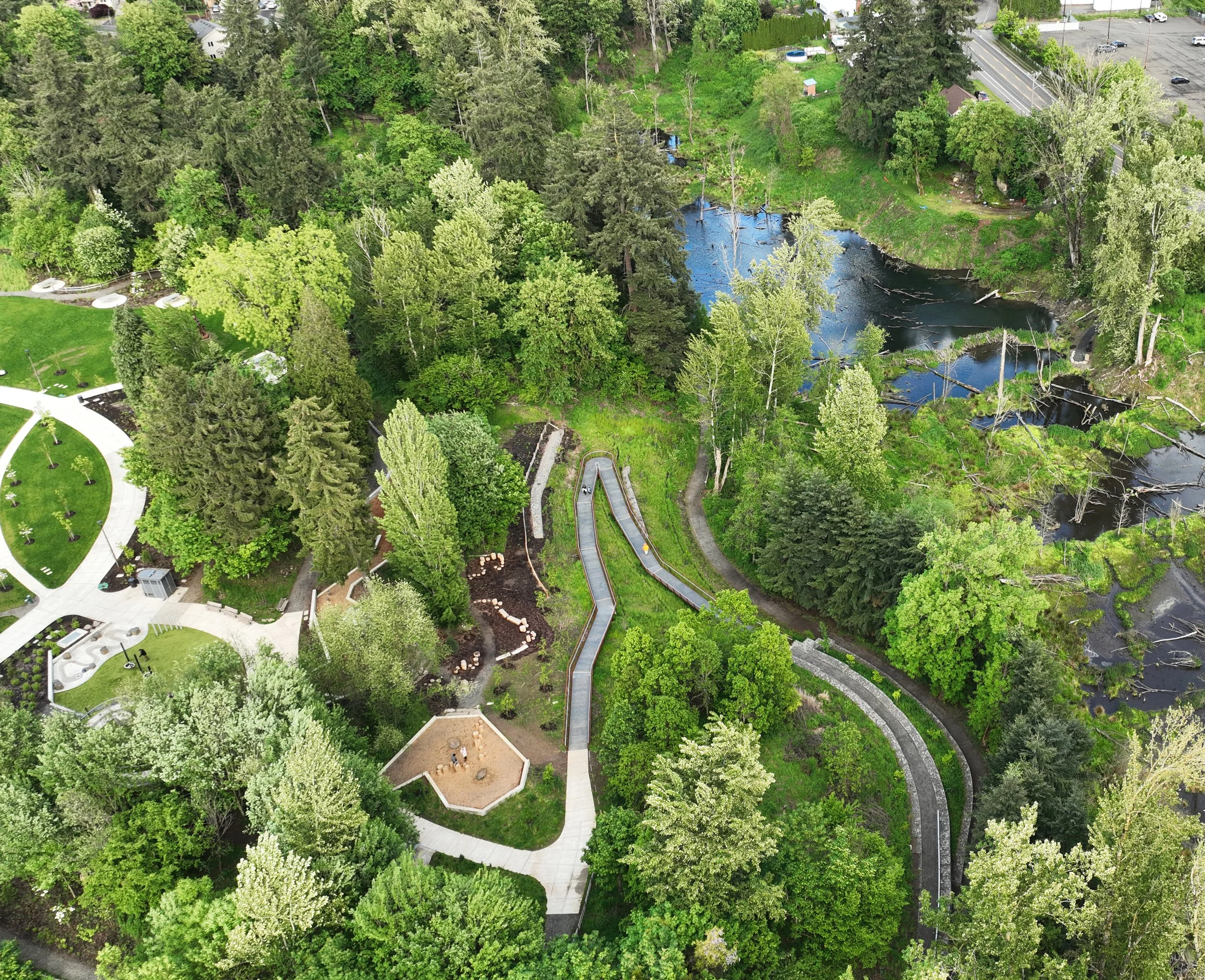
The design of Errol Heights Park skillfully addresses climate action and biodiversity, transforming an underutilized landscape into a climate-positive, biodiverse, and community-rooted public space.
Carbon Drawdown
A net gain of 257 trees and a strong focus on native plantings make Errol Heights Park a model for carbon capture. Native and climate-resilient species reduce water use to the establishment period only. In the lowland natural area, low-impact gravel trails protect existing tree roots and limited heavy machinery impacts during construction. By prioritizing walking and biking access—and omitting parking—the park supports low-carbon transportation.
Climate Resilience
The park provides a shaded, green refuge from rising temperatures. The preserved mature canopy combined with newly planted trees will reduce urban heat for decades to come. The design concentrates development on upland terrain, safely distanced from fluctuating water levels. A splash pad offers a cooling feature. Slope stability is achieved by removing unconsolidated fill at a former illegal dump site and supporting the regraded slope with gabion walls. A preserved natural area, expansion of existing forest canopy and addition of native and pollinator plants support wildlife on land and in water. The park supports people’s health and wellbeing with highly accessible, inclusive experiences—from quiet nature immersion to vibrant community gathering—and enhances food security with a protected community garden and new fruit trees.
Come learn more about this vibrant park’s ecosystem services, biodiversity, and role in community empowerment!